Showing posts with label Border Blaster. Show all posts

Friday, February 13, 2015

Valentine's Blues from Texas and the Great Beyond

It’s not even a tone, more like a pulsing; a spot on the dial where one moment there is a faint sound and the next there isn’t, then there is, then there isn’t. It could almost be Morse code; something, nothing, something, nothing, di, di, da. I bend down closer to the dashboard speaker and try to focus on it. Gradually it becomes a voice, then I realize it’s a woman’s voice, but still far too faint for me to understand anything she’s saying. But she’s saying something and for me. It’s a human voice, and even if I have no idea what she’s saying, I can hear the sympathy and warmth in it.

Stevens taps on my shoulder. I look up. “You shouldn’t do that,” he says. “You may need to start driving any second now.”

So I sit up and put my hands back on the steering wheel. The minutes pass and slowly it gets louder until I can start making out her words.

http://www.amazon.com/Friend-Devil-Brendan-McNally-ebook/dp/B004VXK1LK"Because we’re all just trying to get back home. Isn’t that all that any of us are doing? Trying to get home."

And hearing her say that, I’m thinking to myself, well, I can’t speak for the fellow next to me, darlin, but it’s all I’m trying to do, I’m just trying to get home.

"Home, it’s a word we say all the time, but do we ever really think what it means? Home isn’t just a place we go to eat and sleep. It’s really the place where we come from and where we will all ultimately return. That means it’s not really an actual physical place. It’s really a spiritual place, because it is where ultimately our body and soul go to reunite with the rest of the universe. Your little gray home on the Wabash is simply a temporal representation of that great final reunion with the Sun!"

"Oh, man,” I say.

"What is that?” demands Stevens sharply, his voice teetering on the edge of disgust.

"Some lady on the radio,” I say. I’m about to add, she sounds like a sweetheart, but I don’t. I’m not going to share that with Stevens.

"Sweetheart? Are you nuts? That spook? That’s Rose Dawn, the clairvoyant.”

"The what?”

"She has a program on that Mexican station. Goddamn spook, she talks to the Great Beyond and gives answers to listeners’ questions. Rose Dawn. She’s a crazy bitch. The woman is disgusting.”

"We need to have faith that it’ll all work out. We’re all, each of us, just pieces in a grand celestial mosaic."

"Turn that shit off,” shouts Stevens.

"Fuck you,” I say. “It’s my radio.”

"It’s not your radio. This is a stolen car.”

"Yeah, well, I stole it, so shut up and if you don’t like it, then get out!”

"We’re all of us broken, so it doesn’t matter. Find your strength in knowing that!"

"I hate that crap!” fumes Stevens. “All that Celestial Hey Diddle Diddle! She’s the worst.”

"We’re all imperfect and that makes us perfect. We’re all damaged and that makes us strong."

"Unity of opposites, you’d think the crazy bitch invented it,” sneers Stevens.

"Well, I’d rather listen to her than that phony goat gland doctor,” I say.

"Hey, don’t you go disparaging Doctor Brinkley. He’s doing a marvelous service for mankind.”

"What? Transplanting goat scrotums?”

"That’s a legitimate business, but, more importantly, he makes folks understand that their Number One Priority isn’t over the rainbow, it’s right between their legs.”

"Shut up, I’m listening!”

"I’m hearing you out there, your voice calling from the other side. I’m listening, please speak to me. Do you have a message?"

"Yeah,” I laugh. “Get me the hell out of here!”

"Did you say you want to get out? Then be free!"

That instant, the marshmallow fog vanishes and, with a giant bump, we land on an asphalt roadway, right in the path of a blue Plymouth, coming at us from the opposite direction. We both swerve to keep from hitting each other. He hits his horn and lets it blast for at least ten seconds as he heads past us. Up ahead, I see a road sign that says Tupelo ten miles.

(Excerpt from Friend of the Devil,  available on Kindle)

Thursday, November 7, 2013

More Heard It on the "X"

At three minutes to, the light in the announcer’s booth comes on and I can see that Billy Bays, one of the station’s afternoon announcers, has come in. He greets us and then he and Raoul do a quick check and he smiles and gives me a thumbs-up. They’ve got about a dozen different announcers doing shifts at the station. They’re all bright, sunny guys, and everything they say always has an exclamation point attached.

“Thirty seconds,” says Raoul.

I nod and begin quickly playing the melody to the opening instrumental, which is a rolling medley of Sunshine Trails and Happy in the Saddle. When we go on the air, he’ll have me playing in the background and then, once Billy Bays finishes doing his thing, he’ll switch that mike off and bring me up to full.

“Ten seconds.”

Billy Bays and I both nod. Then Raoul holds up his hand for five, four, three... Then the on-the-air light comes on and he points to Billy Bays, who immediately starts speaking: “The Royal Consolidated Chemical Corporation of Chicago, Illinois, is proud to present The Peruna Program! Featuring America’s favorite singing cowboy, Slim Gatlinburg! Take it away, Slim!”

http://www.amazon.com/Friend-Devil-Brendan-McNally-ebook/dp/B004VXK1LK/ref=sr_1_4?ie=UTF8&qid=1383852652&sr=8-4&keywords=friend+of+the+devil
My strumming gets fiercer, as Billy Bays' booth light goes out. I let it go on another thirty seconds or so, then I start talking while I continue to pick and strum.

“Howdy there, friends and neighbors, this is Slim Gatlinburg, your saddle pal, host and good neighbor along the way. Golly, I’m glad you’ve come by my campfire to visit, because we got a really swell program ready for you today, some songs I know you’ll really like. Now here’s an old favorite of mine, My Oklahoma Home.”

When it’s springtime on the prairie, 
And the sagebrush is beginning to flower 
That’s when I’m riding back to my Oklahoma home 
Where the trees sing in the breeze 
And the Sooner Sun starting to tower 
‘Cause that’s where this cowboy’s sweetheart is waiting 
And soon we’ll be celebrating 
On my Indian pony I’m riding 
Over the prairie we’ll be gliding 
Back to my Oklahoma home.

Now I do the chorus. Needless to say, this is something I wouldn’t be caught dead playing in a saloon. But I’ll sing it on street corners when the audience tends toward families and maiden aunts and kids who go to sleep each night needing to believe cowboys all drink soda pop and carry banjos while they’re riding the range. It’s for people who don’t ever think about dustbowls and hungry, thirsty cattle and skies that are always gray. Now the second verse.

When it’s springtime on the prairie
And we’re riding along the trail
Watching the gray white dove above me
And hearing the peeping quail
That’s when my heart is laughing,
And I know it won’t be long
‘till she’s riding her pony beside me,
back in my Oklahoma home.

By now, it’s like a big chunk of my brain has stepped outside for a smoke. The problem with singing in a broadcast studio is there isn’t anyone in the audience to fix on. I try singing to Raoul, but, being an engineer, he’s not hearing any music, only sound levels and interference. Suddenly I start wondering again what the hell I said or did that got him all pissed off so much. All I did was ask about that guy. Is the reason I never heard about him that everyone is so scared of him they don’t even mention his name?

I do another song, one about rolling wagon wheels, followed by one about campfires and shooting stars. And the whole time I’m singing it, I’m thinking about the way Christine looked down her nose at me this morning when I was visiting the office. The nerve she has ordering me to provide song lists without bothering to say who’s asking for it. Those people all act like they’re doing me a big favor having me sing for them and that the five-dollar bill they give me after each show is a lot more than I’m worth, but I know it’s their way of keeping me on a short leash. If I wasn’t pulling mail, I’d be long gone. And if I wasn’t pulling a whole lot of mail, they wouldn’t have added the Good Neighbor Get Together to my workload.

I start to strum another song, but then I see Raoul waving for me to start my first commercial break. I take my left hand off the neck and take the first script from the stand.

“You know, folks, when you’re out riding the range, day after day, I can tell you, there’s nothing worse than having a sluggish system. Do you ever feel like that? Now, you’re probably just like me, most of the time strong and regular, but sometimes we all need a little help. That’s why I want you to try Peruna, with the absolute, positive understanding that it’ll restore you to a regular state or your money will be cheerfully refunded.

“Every day we get hundreds of letters from folks just like yourself who’ve been troubled by sluggishness and, after using Peruna, they’re right back to their old active selves. Peruna, the modern miracle medicine made by your friends at the Royal Consolidated Chemical Corporation of Chicago, Illinois. Just send two dollars to Peruna, care of this station, Del Rio, Texas. And please tell them Slim Gatlinburg sent you!”

And I look again at the clock, twenty minutes have gone by, which means I’ve still got an hour and forty minutes left.

“Now here’s one of my favorite songs. It’s called Under the Blue Wyoming Moon and it goes like this.”

Yippee-kai-yai-yay,
oer the hills the doggies play 
And I’m happy in the saddle again!
 (Excerpt from Friend of the Devil, available on Kindle here).

Tuesday, October 1, 2013

The Road to Del Rio XII: From Wandering Bluesman to Corporate Singing Cowboy


Just as Herbert T. Barrow might be the last man in the world to see the face of God in anything, even when staring God himself in the face, he is also the last man in the world to see himself existing anywhere on a corporate ladder. He's just a wandering bluesman, playing streetcorners and saloons to anyone with a nickle or dime to put down. True, at the moment, he's found himself a nice little $5-a-day radio gig shilling laxatives and singing cowboy songs over the Mexican Border Blaster, XER, but that's all it is. Every day he rides a taxi across the border into Mexico, does his show, collects his five bucks, rides the taxi back to Del Rio and that's pretty much that.

When Part II of Friend of the Devil opens,  Herbert is standing in the local offices of his employer, the Royal Consolidated Chemical Company, summoned by Christine, the imperious, just-out-of-secretarial-school receptionist and so far, the only person from the company he's ever actually met. She tersely informs Herbert, that from now on, he is to submit for review a playlist of the songs he's going to sing five hours before each day's show. This strikes Herbert as odd, since up until now no one from the company has shown even the slightest interest in what he does on the air. In the world of border-blaster radio, only one thing matters; how well a performer can "pull mail." A singing cowboy might well be the best yodler on the planet, but unless he can persuade listeners to order products and send in money, he's useless to them. Apparently Herbert, or 'Cowboy Slim Gatlinburg,' as he calls himself, pulls in mail just fine. Though Christine invokes the name of their never-seen boss, Mr Klingman, Herbert guesses it's merely something she's concocted to exert control over him and other would-be minions. Instead of writing anything down, he reels off a list of made-up song titles, and before she can say anything, Herbert bids her a good day and leaves.

Once outside, standing in the bright Texas sunshine, Herbert sees it's noon and time for lunch and strolls over to the Tastee Diner for a bite. Along the way, he greets people on the street he knows. At this point Herbert has been living in Del Rio about three months. Things have been going well for Herbert, so well, he's almost allowed himself to forget the craziness he'd gone through riding with Bonnie and Clyde, being pursued by Texas Ranger Captain Frank Hamer, as well as a band of fortune hunters and always with God and the Devil nearby, watching over it all, and betting on what they think Herbert might do next. But as tempting as it might be to dismiss it all as nothing more than a very bad dream, Herbert knows with complete certainty that these last three months of peace are nothing more than a between-the-rounds respite and that it's just a matter of time before Mr. Stevens and the Other Guy start it all up again.

Little does Herbert realize that the clockwork, corporate and celestial, has already started turning around him.

Following is an excerpt from Friend of the Devil, available on Kindle.

“What do you want, Mister Stevens.”

“Besides that song, nothing much. Wanted to say hi and to tell you there’s no hard feelings and that, you know, I still owe you a favor, anytime you might want to collect on it.”

“So, are you and, that guy, still got a bet going on me?”

Stevens frowns. “That guy? Are you talking about God?” The way he says it suggests he half expects the man might come suddenly and smite us both silly.

“He never gave me a name,” I tell him.

Stevens chuckles. “Well, you know, he has lots of names.” He fingers his beard reflectively, then adds, “but don’t we all?”

“Answer my question.”

“Oh, we’ve always got a bet going over this or that. The fate of the world can be such a complicated thing.”

“Plus the side bets.”

“Oh, yes,” say Stevens, his eyes twinkling like he’s glad someone’s finally gotten this colossal joke of his.

“And so that’s where the real action is, isn’t it?”

Stevens smiles.

“Does he understand that?”

“Hey!” Stevens rolls his eyes as might a young girl. “I have no idea,” he says. “When somebody’s eye is always on a bunch of sparrows, it’s hard to tell what else they might or might not understand.”

I don’t say anything. He looks like he’s about to leave. But then he turns back and asks, “So, are you going to sing my song or not?”

“It’s your song?”

“You said it yourself, man pays the money, so it’s his song,” he says.

Tuesday, September 10, 2013

The Road to Del Rio XI: Heard It on the "X"

Back when the rest of America was still stuck in the Great Depression, there was one place where everyone seemed to be doing just fine, thank you very much. That place was Del Rio, a bustling little town in South Texas right on the Mexican Border. When the rest of the country was out of hope, Del Rio had so much of it they were blasting it out every day and inviting the whole world to help themselves to. And this wasn't the spiritual sort of hope. Heck no! What Del Rio was offering was of the purely physical sort. What Del Rio was selling was sexual rejuvenation.

"Yes indeed, friends and neighbors and all you fine folks out there in Radio-Land, if you're sexually weak, sexually impotent, sexually dead. If you've got a flat tire and you're afriad that there's nothing left to live for, that all you're doing with your so-called-life is marking time between now and when you're laying there on the cold grey slab in the undertaker's parlor. If this describes you, then I want you to listen very closely to this message I have for you today during this period of broadcast. Because if you listen to what I say and do exactly as I recommend, you too can return to the bright sunshine of full sexual health and vigor..."

It all started in Milford, Kansas in the early 1920s where there was this phony doctor named Brinkley; J.R., John Romulus Brinkley. Dr. Brinkley had developed one of the greatest money-making scams of the 20th Century. It involved transplanting, or at least claiming to transplant, slivers of testicle from young billy goats  into those of well-heeled, but poorly-performing, middle-aged men. About all Brinkley probably did was make an incision, inject some colored wate, followed by just enough sewing-up afterwards that the patient had to spend a few days with his johnson sheathed in bandages, during which time he had little to do but dream wildly of all the fun he was going to have with his masculinity fully restored, of being a stallion, instead of a gelding, of being, as Dr Brinkley never tired of promising; "the ram that am with every lamb!"

Needless to say, Brinkley's goat gland proposition worked well enough that his patients convinced themselves that they had it back and thanks to mind-over-matter and a lot of word-of-mouth, Brinkley was making himself a nice little pile of dough. But word of mouth advertising wasn't enough. Brinkley needed to find a way to really get his message out and bring in the suckers in sufficient number to make him a millionaire. The answer, Brinkley realized, was radio.

The "Radio Age" had begun a few years before, and Doctor Brinkley was one of the first people to recognize its immense potential. He built a radio station in Milford named KFKB (for Kansas First, Kansas Best) and for a couple years he was wildly successful. But then two things happened. First, Brinkley, not being the sort of person who could restrict his vocal ruminations purely to matters of sex and glands, started veering off into politics. He had a golden voice and an authoritarian manner that was also warm and folksly. People ate up what he had to say, whether it was about sex or God or politics. He decided to run for governor, but the powers that be used a technicality to keep Brinkley off the ballot. So he ran as a write-in candidate and he would have won, except that the reigning political powers were able to disqualify all the write-in ballots that were not perfectly spelled.

At the same time, the Federal Government in Washington, alarmed at the anarchy going on over the airwaves, moved to regulate radio broadcasting, demanding that it be done in the public interest, and outlawing baldfaced requests for money that radio hucksters like Brinkley were engaging in. In short order the the newly constituted Federal Radio Commission shut down Brinkley's station. Brinkley left Kansas and vowed he'd never let anyone ever tell him what he could or could not do.

The solution, he soon discovered, was on the Texas-Mexican border.  The town fathers of Del Rio approached Brinkley and showed him all their town had to offer to a free-wheeling guy like himself. He could set up his hospital right there in town, they recommended he simply take over a floor of the Roswell Hotel. All they asked was that Brinkley do the right thing and spread the wealth around and not burn the locals. Beyond that, they didn't really care what he did with the suckers coming down on the train with $800 burning a hole in their pockets.  These were conditions even Brinkley could understand and respect. They shook hands all around.

Instead of building himself a hospital, Brinkely did indeed rent out a floor of the Roswell and called it the Brinkley Hospital. What he built instead was a radio station, named XER, the most powerful one in the world, just across the border in Mexico. Now he was free to broadcast anything he wanted and he did. Brinkley would spend hours each day preaching about sexual health and his miraculous goat gland operation. He'd mix it up by bringing down hillbilly bands to play music and sing. The airtime he didn't use for his own purposes, he rented out to preachers, singing cowboys and other hucksters, all of whom had come down to Del Rio for the same reason, to rake in the dough. It was a kind of paradise, far away from all the trouble and strife going on in the rest of America at the time.

Even so, if what was happening in the rest of the US might have seemed very far away to the good folks in Del Rio, to the people in the vast expanse of America,  Del Rio seemed like next door. Day after day, people let Dr. Brinkley and the other "X Station" stars into their homes. The music they played became the music everyone in America listened to: Hillbilly, Gospel, and Cowboy.

And it is into this world that Herbert T. Barrow finds himself cast. He has finally removed himself from the clutches of Bonnie, Clyde, the fortune-hunters, as well as God and the Devil. When the section opens, it's probably three months later and for all intents and purposes, Herbert is another person altogether.  His career as XER's singing cowboy is well underway. He sings cowboy songs by day for five dollars a session, and earns a heaping pile of nickles, dimes and quarters every night he plays blues at the Black Pussy Cat Cafe. Herbert is well on his way to becoming a local in Del Rio, somebody everyone knows and likes. Who knows, he just might settle down there and grab his own permanent piece of the Del Rio Dream.  But then, later that day,  when he's at the XER studios to do his program, a woman passes him in the corridor. Their eyes meet and even though neither exactly realizes it, they have both met their destiny.

Inside, everything is friendly, though businesslike; a mix of Anglo and Mexican secretaries, engineers and executives purposefully bustling about, speaking in a seamless patter of Spanish and English. At one end of the room are some leather couches. I sink into one and take my guitar out of its case and start tuning up. I’m there about three minutes when Peggy, the program director’s assistant, comes in with her clipboard in hand and says: “You’ll be in Studio C today, Slim.”

“Is it clear yet?”

“In five minutes. They’re just finishing up something now.”

“Who’s the engineer today?"

“Raoul Ortega.”

“Great,” I say, “lead the way.”

Peggy takes me through a rabbit warren of narrow, airless corridors with banks of glowing electrical panels on either side of us; large, wide metal cabinet doors with chrome handles jutting out that you hit if you walk too close to them.

We turn a corner and there’s hazy light coming from a window at the end of the corridor. That’s when I see a strange, exotic woman practically floating up the corridor towards us. She’s got on a diaphanous rose-colored gown that’s flecked in gold and her face hidden behind a veiled turban. The scent of jasmine wafts into my nose and suddenly I’m imagining the half-shadowed interior of some ancient, middle-eastern temple, rows of smooth Egyptian columns, scrolls, hieroglyphics, obelisks, statues of forgotten idols.

“Good afternoon, Peggy,” she says pleasantly as she walks by.

“Good afternoon, Rose,” says Peggy.

“Good afternoon, Slim,” she adds.

“Afternoon,” I say.

I turn around and watch her disappear around the corner.

“Who’s that?” I ask Peggy.

“You mean you don’t know?” asks Peggy, arching her eyebrows. “Well, she certainly knows you.”

“I have no idea,” I say. “Who is she?”

“Why, that’s Rose Dawn.” 

(Excerpt from Friend of the Devil, available on Kindle here)

Sunday, June 30, 2013

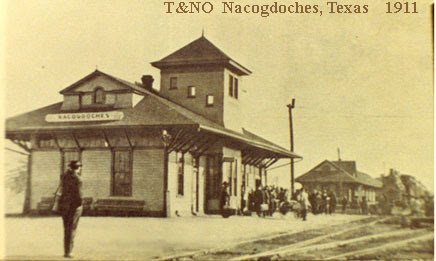
The Road to Del Rio VI: Stoned in Nacogdoches


After Arkansas, Herbert T. Barrow drives into Texas. He reaches Nacogdoches, a small city in east Texas, ditches his car, checks into a hotel, takes a bath and then hits the hay in a real bed for the first time since bolting out of Knoxville nearly a week earlier. When he wakes up the next day Herbert begins planning the next step of his journey.  Herbert's plan is to go to the train station, and buy tickets to Del Rio, down on the Mexican border. From what he's heard listening to the radio, he figures it will be easy to find work there as a singing cowboy on XER, the Mexican border blaster radio station.

After everything that has happened to him over the last few days, Herbert figures it wouldn't do him any harm to "take a cure" from all the marijuana he's been smoking.  He reckons Nacogdoches is a good place to start, since it's not exactly famous for its "tea pads" and jazz clubs. But as it turned out, Nacogdoches did indeed have its own local viper scene. Walking past a Mexican bakery, Herbert smells something fragrant and friendly wafting from inside that definitely isn't bread being baked. A minute later he's getting high with the bakers who sell him a lid of primo marijuana.  And that's when everything starts going wrong.

Stoned, Herbert is suddenly too paranoid to go buy tickets at the train station. He ends up using some of the money he'd taken from Captain Hamer and uses it to buy a third-hand Marmon automobile, then finds a gin mill and gets very drunk before staggering back to his room and going to sleep.When he wakes up, there is a heavy rainstorm going on outside. In a flash of stoned brilliance he decides he should use it as a time to leave town in case Hamer is closing in on him. He packs his bag, goes downstairs, pays his bill, gets into his car and leaves. That's it for Nacogdoches, except that in the upcoming chapters, when Herbert falls unwillingly into the company of Bonnie & Clyde, cousin Clyde offers him some marijuana that, judging from the taste of it, he figures comes from the same Mexican Bakery down Nacogdoches way.  There is actually a true Bonnie and Clyde story about this I will relate in a future post.  But let's not leave the subject of Nacogdoches quite yet.

Nacogdoches bills itself as the first city of Texas, which is true in more than one way. For ten thousand years before the White Man showed up, the area was the center of a thriving Native American civilization known variously as the Caddos or the Alabama-Coushatta.  By the time the first Spanish explorers showed up, that civilization was long gone though the Caddos and Alabama-Coushatta were still around, mainly peacefully farming.

The Spanish saw it as a natural place to establish their side of the border with the French empire and built a stone fortress there back in the early 18th Century. By the late 18th Century, it had become clear that the French weren't really any kind of threat and the fort was dismantled.  There was a Spanish population.living there and when the fort got dismantled, the order came for the local population to return south.  But it turned out they didn't want to and elected to stay. Their leader was an officer named Gil Y'Barro and in a way, what he and his people did there resembles the settlement patterns of the Anglos who would settle there in a few more decades.


Nacogdoches became a pueblo, a settlement town far from the close control of the imperial authority.  The American settlers who came there not long after accepted the Spanish authority, but mainly it was lip service in exchange for land grants. There were numerous uprisings and short-lived Texas Republics established, including one called -- shades of the Marx Brothers -- the "Republic of Fredonia."

Eventually a longer lasting Texas Republic was founded, which later joined the United States and then the Confederacy. Nacogdoches was always a big town during the 19th century, fed largely by the cotton that was grown there. It was also a university town, home of what is today Steven F. Austin State University.

Early in the 20th century, Nacogdoches was big enough to support at least one theatre. Once Groucho Marx performed there when he was still just another unknown comedian and according to legend, Groucho informed the audience that "Nacogdoches is full of roaches!"

I'm sure Groucho wasn't just making it up.

The following is an excerpt from Friend of the Devil:


This rainstorm is a real East Texas gullywasher. I’ve been sitting here, stuck inside this car for two hours and it still doesn’t give any sign it’s going to ease up anytime soon. I think something is broken. I can get the engine to start, but the wheels won’t turn or anything. My stupid fault. Why did I have to drive off during a rainstorm? Why? The exact same reason I didn’t ditch the car and buy a train or bus ticket to Del Rio. In a word: marihuana.

Saturday, December 29, 2012

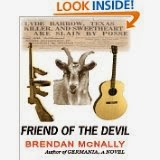
Friend of the Devil? No friend of His!

"Friend of the Devil" was one of the most universally popular songs in the Grateful Dead songbook. It tells the story of a man running from the law who gets briefly helped by the Devil, who lends him twenty dollars, only to come back later, taking it back and vanishing in the air. That's most of the story right there, other than the fact that after the Devil loaned him the 'twenty bills,' he spent the night in Utah in a cave up in the hills.

My novel "Friend of the Devil" definitely takes its inspiration from the Dead song. The protagonist, Herber T. Barrow, is also running from the law and he also runs into the Devil. But this time it's Herbert that does the Devil a favor, not the other way around. Without wanting to, he puts the Devil in his debt, and then refuses to let the Devil pay him back. And in a way, that's where the fun starts.

BUY THE BOOK


The Grateful Dead song seems to take place sometime in the mythic Old West. My Friend of the Devil takes place in 1930s Texas, Mississippi, Missouri, and Arkansas. Even so, it's still an age of desperados and lawmen. Herbert, in accordance with time-honored Western tradition, is skedaddling for the border. There, he believes, he'll be able to hide out, albeit in plain view, while working as a singing cowboy on XER the mega-powered "Border Blaster" radio station that sits just across the Rio Grande in Mexico.

Getting there is no easy feat, since neither God nor the Devil is a friend of his!

Following is an excerpt from Friend of the Devil, a novel: 


"From the corner of my eye, I can see him reaching back into his waistcoat pocket, pulling his watch back out and popping open the lid. “All right now,” he says. “Exactly how fast are we going?”

I take a quick look at the speedometer. “Ninety,” I say.

“Ninety,” he says back as he fumbles with the stem on top, turning it and at the same time pulling it up and down. I take another look in the mirror and see that ty he white light has nearly caught up with us, but that it’s already broken up into an array of colors from the rainbow, only they’re all glittering and changing.

Stevens holds the watch up with his thumb on the top button. “Okay,” he says, “get ready. Here we go!” He presses down the top button and immediately it’s like we’re in a small boat carried along by a giant wave. I feel the car lifting from the back and we’re rolling and swaying and the blackness has turned to light, only now it’s like we’re on a river inside a bank of fog.

“All right,” says Stevens, turning around and facing forward on his seat. “That’s that!” He smiles like he’s very satisfied with himself.

“That’s what?” I ask. “Where are we?”

“We’re neither here nor there,” he declares happily. “It might just be a good time to light up one of them reefers you got in your shirt pocket.”

Monday, December 3, 2012

100 Baby Chicks (John R. WLAC)

BUY THE BOOK

John R. never worked on the Border Blaster. But he had all the hallmarks of a great old-time radio announcer. He talked like he was black, and he was endlessly enterpreneuring. Just like that greatest Border Blaster DJ of all times, Wolfman Jack. Listen as he sells 100 baby chicks, which is one of the things that Border Blaster guys were always selling. Herbert Barrow, the hero of my novel, Friend of the Devil, would
definitely have ended up sounding like this guy, given a couple of more years behind the mic. Enjoy!

http://www.youtube.com/watch?v=C5Xr0CRVT6k

Friday, October 5, 2012

The Legend of Goat Gland Doctor JR Brinkley

Beta, the town in western North Carolina where John Romulus Brinkley was born in 1885, no longer exists, which in a way is kind of fitting, since huge chunks of his life's story were made up in the first place. Brinkley was an almost wholly self-invented man, which is to say, he was a conman, a fraud, and a crook. But Americans as a people have always prized self-invention. It is part of our worship of success.

JR Brinkley was a handsome, distinguished-looking man who spoke beautifully. He'd always dreamed of being a doctor, but this was not possible, since his own education had been limited to a few odd years of schooling in one-room, country schoolhouses. He worked for a while as a telegraph operator as well as for different railroads, which allowed him to leave the hills and relocate to New York City, where he immediately adopted big-city ways. He apparently tried night school at one point, but quickly lost interest in the long process of education as a way to respectability and success. Instead he found a shortcut.

BUY THE BOOK

Brinkley's career began working as a guide at a storefront "medical museum," a phenomenon that existed in big cities at the turn of the century. They pretended to be educational establishments, but they were more like carnival sideshows.  Their real purpose was to draw in men who worried that they might be suffering from a venereal disease or some other ailment of the reproductive system.  While the visitors stared at the various exhibits, Brinkey and his cohorts stood discreetly in the background, waiting for the right moment to present themselves.  They were always very well dressed, often they sported mustaches and vandyke goatees along with pince nez spectacles to inspire doctorly confidence. He learned to read their body language so he'd know the right moment to step in and offer medical advice. In a matter of seconds, the pigeon was ushered upstairs, given an examination, a consultation, and quickly offered a phony cure and just as quickly separated from whatever money he had on hand.

Brinkley did this for a while, then struck off on his own. For a while he had a partner, with whom he plied the phony doctor trade in different cities in the south. They offered a cure for virility problems, an injection of some "electrical serum," that was really nothing but colored water for $25 a shot, a fortune in those days. In the process they ran up massive bills with local tradesmen and businesses and then skedaddled at the last minute.  After pulling it off successfully in a number of towns, they eventually got caught and put in jail. But Brinkley was able to charm his way out. After that, Brinkley didn't have partners. He strictly worked alone.

Brinkley got a medical degree from a mail-order diploma mill, which billed itself as an 'eclectic' university. For a while Brinkley worked as a doctor for a meat packing plant. During World War One, he was briefly a doctor in the U.S. Army, but he apparently showed so little interest in his duties he was soon let go. Brinkley wasn't the sort to have any boss but himself.  He went to Milford, Kansas and set up shop there.

The way Brinkley told his own story,  and there's no way to tell if it was true or not, he had his epiphany after witnessing a young male goat going at it with a female. He mentioned it to a patient who'd come to him, suffering from a "flat tire;" or, loss of "sexual vigor."  The patient pleaded with Dr. Brinkley to, perhaps, transplant some of the goat's testicles onto his own.  Brinkley did, and lo and behold, the operation was such a success that the man's sexual potency soon returned and a mere nine months or so later, he had sired a son, whom he gratefully named, "Billy."

Within a very short time Brinkley found great success with his goat gland cure.  The patients came in, Brinkley's hospital grew. To advertise it, he bought a radio station, KFKB. At this time radio was still in its infancy, and though it had many proponents,  hardly any of them could grasp its tremendous commercial possibilities. But Brinkley did. He instinctively knew it was the perfect way to reach out to people.

Brinkley was also perfect for radio. He had a deep, soft, golden voice and he spoke beautiful, dignified English. He came off as familiar and reserved, friendly and authoritarian. He spoke about the things you weren't supposed to talk about, sex and glands and energy.  All energy is sex energy, he'd say. With his simple operation, he'd make old men young, he'd turn men from geldings into stallions. People loved what they heard, the loved Brinkley.  The problem was, radio was ceasing to be a wild, wide-open frontier. Radio stations were expected to operate in the public interest. Broadcasters weren't supposed to flat out ask for money, which was what Brinkley did, many, many times each day.

None of it might have been a problem, had Brinkley had the sense to stay out of politics. But he couldn't help it. He was a born outsider, hated anyone telling him what he could and could not say. He spoke out against the authorities in Kansas and the authorities in Washington.  He decided to run for governor as a write-in candidate, and probably would have won, except the authorities  voided most of the ballots for him.  They also shut down KFKB, his station.

But Brinkley wasn't defeated. Far from it. He took his money and abandoned Kansas and did what outlaws traditionally did. He headed for the Border. To Del Rio, Texas , a sleepy little, mostly anglo town on the Mexican border and set up shop there.  Del Rio's town fathers had lobbied hard to get Brinkley to come there. They knew that wherever Brinkley went, lots and lots of money followed. Brinkley set up his Brinkley Hospital, which was really just the second floor of the Roswell Hotel.  But then, in a masterful move, Brinkely built a radio station across the river in Villa Cuna Cohuilla, Mexico. 

A little bit of background: during the 1920s, when the radio craze first burst onto the world, there was no effort at regulation at all, so radio stations popped up all over the dial, often on the same frequencies.  Eventually an effort got set up to rationalize things. Somewhere along the line radio officials from the US and Canada met and carved up the radio band for themselves, leaving the scraps for their little brown neighbors, Mexico and Cuba. Enraged at their treatment, the Mexican government decided it was time to show the gringos what for. They let Brinkley and others set up super-powered radio stations along the border, knowing that the more they irritated Washington, the sooner Washington would agree to a more equitable distribution of the airwaves.

Brinkley was probably not aware of any of this when he decided to make his station, XER, the most powerful radio station on the planet.  It was enough for him to know that his reach extended all over North America and that he could say and do whatever he wanted. He spoke about sex, about glands, about God and government. Needless to say, he was no fan of FDR or the New Deal or the American Medical Association, whom he referred to as the "American Meatcutter's Association." Brinkley also knew how to draw in listeners. He interspersed his long lectures on sexual health with music from hillbilly bands. These included the Carter Family, and in no small part, had much to do with the spread of country music's popularity. He also rented out airtime to anyone else who could pay for it.  And there were plenty of them.  There were radio preachers, psychics, pitchmen, yodelers, singing cowboys. And they were all there for the same reason; it was where the money was.

Even though America was deep in the middle of the Great Depression, there was an unending stream of suckers arriving in Del Rio every day with eight hundred dollars in their hands, hoping Dr. Brinkley's celebrated goat gland operation would give them a new lease on life,  that it would make them, as Brinkley himself liked to put it, "The ram that am with every lamb!"  Patients were encouraged to examine a pen of active young goats kept outside the Roswell Hotel and pick the liveliest.

Supposedly the operation involved transplanting slivers of young goat testicle onto those of his patients. Sometimes they operated, sometimes they just faked it.  Either way, some patients reported miracle results. Sometimes the operations were botched, sometimes the patients got sick from it. Sometimes they even died. Whenever this happened, it was easy enough to sweep it under the rug.  The local medical authorities in Val Verde County, Texas were in no hurry to expose Brinkley as a fraud. Nobody was. He was bringing in far too much money and he was spreading it around.


Brinkley lived in splendor in a massive mansion on the side of which he had his name, 'Doctor Brinkley', done up in large glowing neon lettering. At night the mansion and grounds would be lit up in colored lights. Brinkley had fancy cars. He had several airplanes and he had a massive ocean-going yacht. He often went on trips to Europe, he visited Nazi Germany and met its leader Adolf Hitler, of whom he greatly approved. Life was very good for John Romulus Brinkley.

But Brinkley had enemies. Not powerful ones, but they were vocal and they were relentless. The first blow came when another quack doctor set up a competing hospital in Del Rio, offering the same phony operation, but cheaper. Suddenly Brinkley was finding that the patients he'd gone to such efforts to attract, were being hustled away the moment they stepped off the arriving trains. Brinkley had expected Del Rio's town fathers would be quick to run him out, but to Brinkley's surprise, they wouldn't.  But the enemy Brinkley hated the most was one Dr. Morris Fishbein, a non-practising physician who was editor for the Journal of the American Medical Association. Fishbein had written a series of articles titled "Modern Medical Charlatans," where he went after the different quacks and frauds doing business on the American public. He made Brinkley his favorite target.

In a way, Brinkley's great failing wasn't that he was a quack, a fraud, and a crook. It was that he believed his own lies about himself.  The truly smart criminal is the one who accepts that he lives and operates on the margins of society. He never calls attention to himself and when anyone takes a shot at him, no matter how unwarranted, he must never seek redress.

Brinkley had been at the top for so long that he lost sight of this essential fact. He should have acccepted Fishbein's articles as the very minor irritant they were. He should have had the circumspection to recognize that almost nobody out there in radio-land who listened to his broadcasts ever heard of the Journal of the American Medical Association, let alone read Fishbein's articles. He should have accepted it as the cost of doing business and moved on. But Brinkley couldn't.

Brinkley sued Morris Fishbein for libel and for $250,000 in damages. By doing that, he'd played himself right into Fishbein's hands. The trial only took a couple of days, but when it was done, not only was Fishbein found innocent, but Brinkley was publicly declared a charlatan with blood on his hands. Suddenly the lawsuits began rolling in. The U.S. Government moved in as well, charging him with not having paid his taxes. Even the Mexican authorities went against Brinkley. Mexican army troops came in and seized control of Brinkley's border blaster.  A short time later, a deal was finally reached with Washington and Ottawa to redistribute the airwaves so that Mexico got a fair share.

Brinkley had been a millionaire, but now he was bankrupt. He suffered a series of heart attacks and had to have one of his legs amputated due to poor circulation. He was penniless when he died on May 26, 1942.


FRIEND OF THE DEVIL is a darkly comic, supernatural thriller set in the crazy, colorful world of Del Rio during its legendary 'Border Blaster' era of the 1930s.  Doctor Brinkley is just one of the many characters in the story. It is available on Kindle through Amazon.